
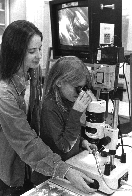
The Redpath Museum's Discovery Day
drew a good crowd of natural history
buffs. Here marine ecology master's
student Kate Holmes introduces Megan
Dow-Allnutt to a small sea creature.
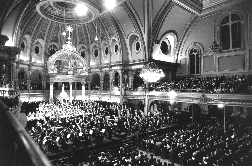
Benjamin Britten's War Requiem isn't for the faint of heart. Touted by many critics as the greatest choral composition of the 20th century, the piece is rarely performed because it's such a demanding undertaking.
The Faculty of Music took on the challenge and has been earning raves for two recent performances of the Britten masterwork. Last Wednesday, more than 400 music students played and sang to an appreciative audience at the National Arts Centre in Ottawa. A standing-room only crowd heard the students'War Requiem on Friday night at St. Jean Baptiste Church here in Montreal (above).
Reviews in the Ottawa Citizen, Le Devoir and the Gazette all lauded the performances, which featured the McGill Symphony Orchestra and Chorus, led by conductor Timothy Vernon, and the FACE Treble Choir, directed by Iwan Edwards.
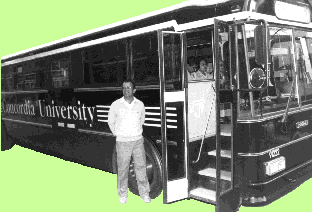
Concordia students were getting fed up. It seems that the drivers on their shuttle bus-which transports Concordians back and forth between the school's NDG and downtown campuses-were no longer asking passengers for their Concordia ID cards. According to students, a number of outsiders, many of them from McGill, were taking advantage of this and using the bus for their own commuting. The result has been longer line-ups and fewer seats. Some students have given up on using the shuttle altogether.
"I think the McGill students should help me pay for my parking tickets," says Concordia commerce student Yair Abehserra in a recent edition of the Concordian newspaper. The front page headline on that issue blared, "This is Concordia's shuttle bus. . . also known as a free ride for McGill students."
Concordia's drivers had stopped asking for IDs largely because of complaints from students. "It was to alleviate the flack from the users on the bus drivers," explains Michael di Grappa, director of administration services and physical resources. But now that students have indicated that a no-carding policy doesn't work that well after all, passengers will again be asked to prove their Concordia affiliation.
Source: Andrew Soong,
The Concordian
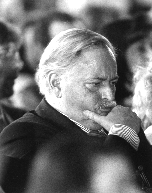
The premier has been taken to task for his referendum-night complaint about the voting patterns of non-francophones. Forty-eight university scholars and artists have sent Jacques Parizeau a letter demanding that he apologize for blaming the defeat of the Yes option on "money and the ethnic vote."
The letter indicts Parizeau for the comment, stating that it "supports a socially dangerous, xenophobic logic, a) by making part of the population a scapegoat, b) by rejecting the pluralism of Quebec society, which contains some communities which are not francophone, and c) by challenging the democratic values upon which our society is based."
French language and literature professor Marc Angenot was one of the 48 signatories. "I thought it was quite an exceptional piece," says Angenot. "I wouldn't have signed it if it was too wishy-washy, but it was extremely specific in demanding that Mr. Parizeau apologize for those remarks."
The effort was organized by Emmanuel Décarie, an art history scholar at Université de Montréal. Other McGill signatories include philosophy professors Mario Bunge and Charles Taylor, mathematics professor Martha Bunge, part-time Slavic studies assistant professor Serge Hervouet-Zeiber and art history PhD candidate Gilles Thibault. Professors at Université de Montréal, Université du Québec à Montréal and Concordia also signed the document. The letter has been published in the Gazette and in La Presse, but Parizeau himself hasn't made any comment about it.
